
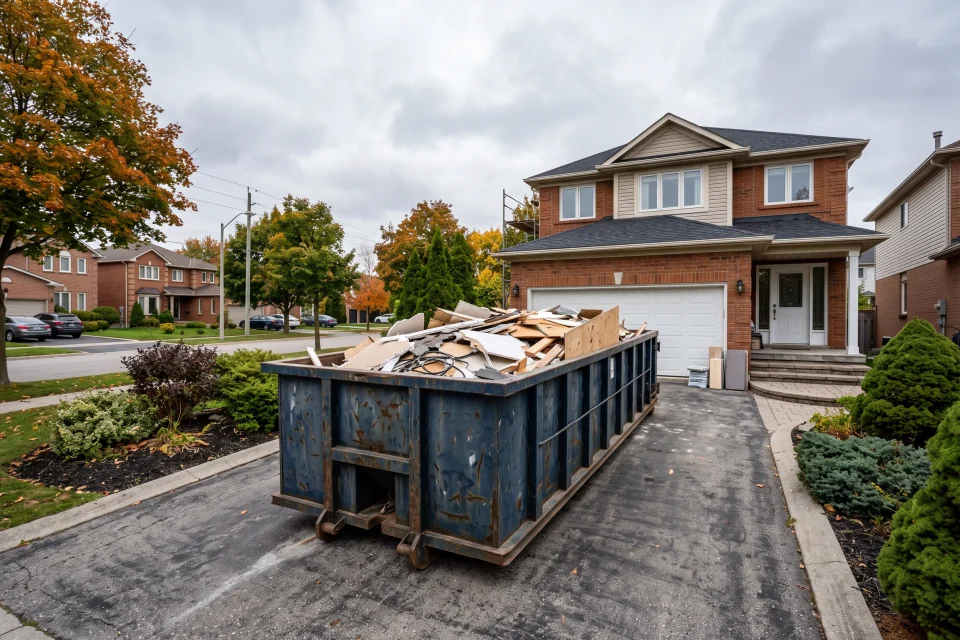
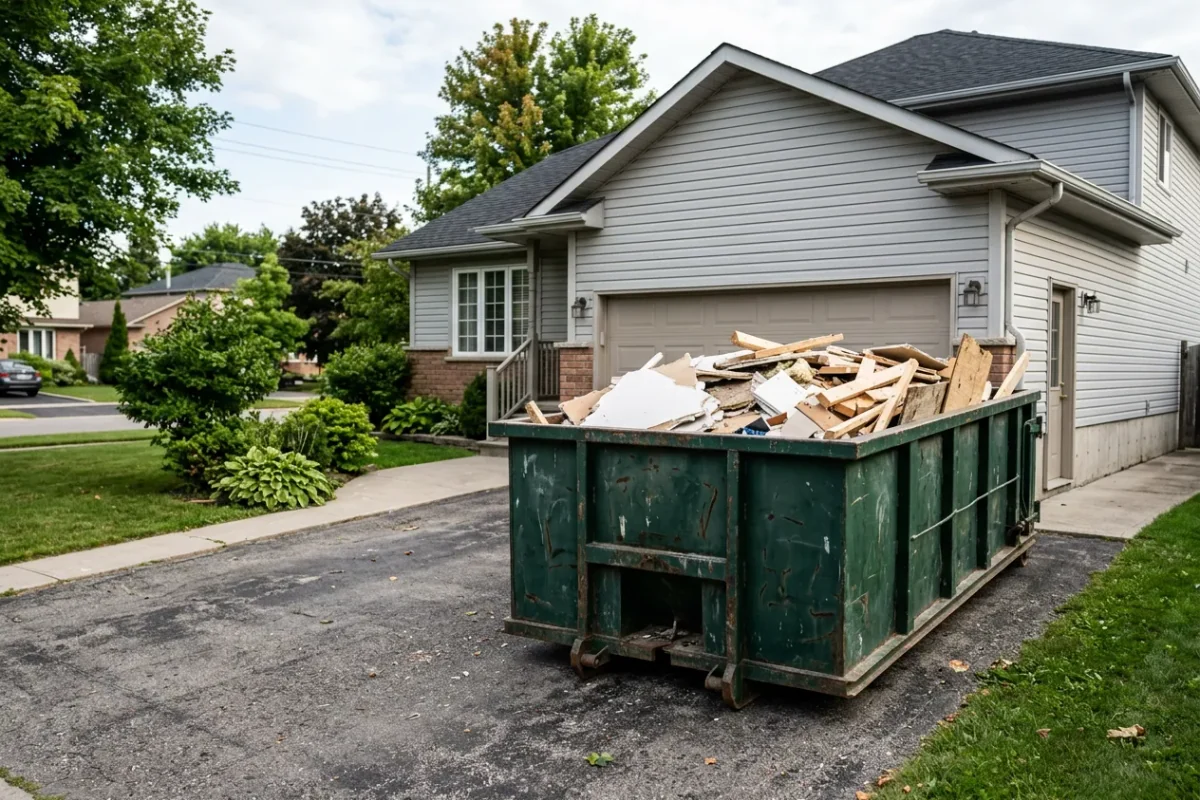
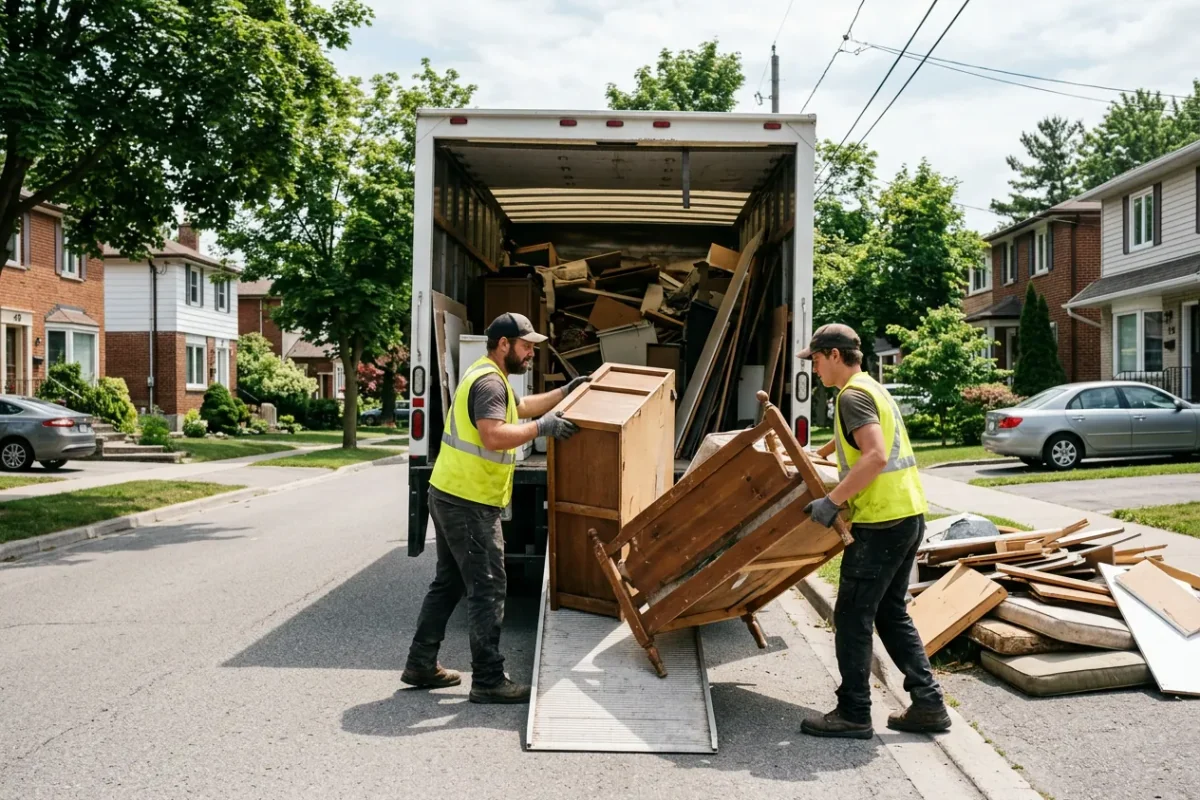
You’re mid-renovation, there’s a pile of drywall and old cabinets growing in the garage, and you need it gone. Do you rent a bin and fill it yourself, call a junk removal company to send a crew, or is this something your demolition contractor should just handle?
Short answer: a bin rental runs roughly $300–$550 a week in the GTA for a mid-size bin, and you load it yourself over the rental window. Junk removal is priced by volume, typically $150–$600 per load, and a crew loads it for you in a single visit. If a demolition contractor is already doing the work, debris haul-away is usually built into that quote at no separate cost, and if it’s not, most demolition companies will haul a load on its own.
What a bin rental actually costs in the GTA
A bin rental is a flat weekly rate for the size of bin, plus a per-tonne overage fee if you go over the included weight. In York Region and Toronto, typical pricing looks like this:
| Bin size | Typical weekly rate | Good for |
|---|---|---|
| 10-yard mini bin | $300–$400 | Small reno, single room, light cleanup |
| 14–16 yard bin | $375–$475 | Kitchen or bathroom gut, average basement cleanout |
| 20-yard bin | $425–$550 | Whole-floor reno, garage teardown, larger cleanout |
Most rentals include a set weight allowance (commonly 1–2 tonnes depending on bin size) and a rental period of 7–10 days. Go over the weight limit and you’re billed a per-tonne overage fee, often $80–$120 per extra tonne, on top of the flat rate. Keep the bin past the rental window and most companies charge a daily extension fee. Delivery and pickup are usually included in the quoted price, but confirm before you book, since some companies quote it separately.
What junk removal costs and how it’s priced
Junk removal companies price by how much of the truck your load fills, not by weight, though very heavy loads sometimes bump the price regardless of volume. A rough GTA range:
| Load size | Typical cost | Good for |
|---|---|---|
| 1/4 truck | $150–$250 | A few pieces of furniture, small cleanup |
| 1/2 truck | $250–$400 | Single room’s worth of debris, small reno |
| 3/4 to full truck | $400–$600+ | Larger reno cleanout, small whole-property clear |
The crew arrives, points at the truck, and gives you a price on the spot before loading. There’s no weekly rental, no overage fee to track, and the debris is gone the same day. The tradeoff is scheduling: you’re booking a single visit, so everything has to be ready and accessible when the crew shows up, rather than filling a bin gradually as the reno progresses.
Bin rental vs junk removal: when each one wins
A bin rental makes sense when:
- The project runs over several days or weeks and debris is generated gradually (a full kitchen reno, a multi-room strip-out)
- Multiple trades are contributing debris over the course of the job
- You or your trades are doing the loading and don’t mind the labour
- The total volume is large enough that a flat weekly rate beats several junk removal trips
Junk removal wins when:
- It’s a single cleanup: one room, a garage clear-out, a furniture haul
- You don’t want to load anything yourself, or physically can’t
- You need it gone today or tomorrow, not over a multi-day rental window
- There’s nowhere convenient to park a bin (tight driveway, condo, no street access)
A demolition contractor handling the haul makes sense when:
- Demolition work is already happening, and you’d rather not coordinate a second company
- The debris includes heavy material like concrete, tile, or masonry that many bin and junk removal companies restrict or surcharge
- You want one firm price for the whole job, demo plus disposal, instead of two invoices
The weight problem: why concrete and heavy debris change the math
Both bin rentals and junk removal are built around typical household and renovation waste: drywall, wood, cabinetry, flooring, furniture. Concrete, brick, tile, and soil are a different category entirely, because they’re dense. A single-axle trailer’s worth of concrete can weigh more than a full truckload of furniture and drywall combined.
That’s why bin companies cap included weight and charge steep per-tonne overage on anything heavier, and why a lot of junk removal companies simply won’t take concrete, brick, or large volumes of tile and soil at all. If your project includes a concrete patio, a driveway, or a tiled bathroom floor coming out, ask specifically about that material before you book a bin or a junk removal company. It’s often cheaper and simpler to have the demolition contractor haul heavy debris directly, since they’re already set up to weigh and dispose of it correctly.
What can’t go in a bin or a junk removal load
A handful of materials are refused across the board, by bin companies, junk removal crews, and landfill and transfer station operators alike:
- Asbestos-containing material: older popcorn ceiling texture, vinyl floor tile and its adhesive, pipe wrap insulation, and some drywall compound in homes built or renovated before the early 1990s. This needs testing and, if confirmed, a licensed abatement contractor before any demolition or disposal starts. We educate on this during any interior scope but don’t handle abatement ourselves.
- Propane tanks and fuel containers: refused everywhere due to fire and explosion risk; return empty tanks to a retailer exchange program or a hazardous waste depot.
- Paint, solvents, and other household hazardous waste: needs to go to a municipal household hazardous waste depot, not a bin or a junk truck.
- Tires: most municipalities and disposal facilities require tires to go through a separate recycling stream; a tire retailer will often take old tires when you buy replacements.
Trying to hide any of these in a mixed load risks the whole load getting rejected at the transfer station, which turns into a delay and sometimes a fee.
Bins on the street: the permit reality
A bin that sits entirely on your own driveway generally doesn’t trigger a municipal permit in Vaughan, Markham, or Richmond Hill. The moment any part of that bin sits on the road allowance, meaning the street itself rather than your property line, most municipalities require a road occupancy or obstruction permit, with its own application, fee, and sometimes a placement diagram. Toronto has a similar requirement for bins placed on the boulevard or roadway.
This is something to confirm with your bin company and your municipality, not something we file for you. If your driveway is too short or too narrow for the bin size you need, ask the bin company directly whether street placement is even an option in your municipality before you commit to a delivery date.
How this fits into a demolition project
If you’re already hiring a demolition contractor for interior work, a kitchen tear-out, a basement gut, or a full renovation strip-out, debris haul-away is typically part of that quote already. That means no bin sitting on your driveway for a week, no second invoice from a junk removal company, and no separate scheduling headache. We load everything ourselves, sort what can be diverted from landfill, and leave the site swept.
If the demolition work is done and you just need the leftover pile gone, or the debris came from a reno another trade handled, debris removal on its own covers that without requiring a full demolition scope. Either way, you’re not stuck choosing between renting a bin you have to manage yourself and hiring a separate hauling company.
Call (647) 824-9839 and tell us what’s generating the debris (a reno, a demo, a cleanout) and roughly how much of it there is. We’ll tell you honestly whether it’s a bin job, a one-load haul, or something to fold into a demolition quote.