NextSite Demolition

Mississauga demolition service

Demolition contractor in Mississauga

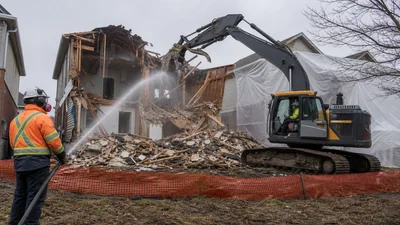
NextSite takes on demolition in Mississauga as an extension of our Toronto and York Region work. We handle teardowns for rebuilds, interior strip-outs, pools, garages and concrete, and we plan each job around the City’s Demolition Control By-law, its tree rules and the access the lot actually gives us.

WSIB

Clearance on request

$5M

Liability insured

Licensed

Ontario contractor

Swept-clean

Debris hauled same day

What changes locally

Mississauga demolition starts with the rebuild plan

Mississauga has one rule that shapes almost every house teardown: the Demolition Control By-law. It is designed to stop lots from sitting empty, so the City ties residential demolition to rebuilding conditions. In practice, that means the replacement plan, the permit and the demolition date have to line up before our crew arrives. We plan the work around whatever conditions your permit carries.

The rest of the job is about the property. South Mississauga has large, tree-covered lots where older bungalows are being replaced with new custom homes. The newer subdivisions further north tend to need interior, basement and pool work more than full teardowns. Wide driveways often make equipment access easy, but mature trees, the Credit River valley and close neighbours can change the plan quickly.

Area by area

Mississauga property conditions

Mississauga covers lakeshore villages, post-war suburbs and newer planned communities. These are the conditions we see most often.

Large lots · teardown-rebuilds

Mineola & Lorne Park

Post-war bungalows on deep, heavily treed lots are steadily being replaced with custom homes. Tree protection is usually the biggest planning item, because many trees on these lots are large enough to need a City permit before they are cut or disturbed.

Lake edge · Credit River

Port Credit

Older homes, infill and mixed-use buildings close to the lake and the river mouth. Smaller lots and closer neighbours mean tighter load-out routes, and properties near the valley can need conservation authority checks.

Historic village core

Streetsville

Older houses and main-street buildings sit next to newer streets. Heritage status should be checked early here, because a listed property needs 60 days’ notice to the City before a structure is demolished.

Post-war homes · busy corridors

Cooksville & Applewood

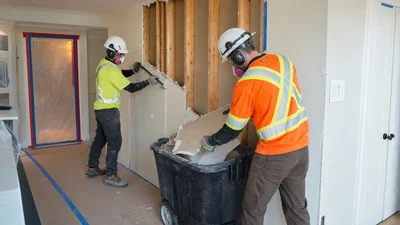
Bungalows, split-levels and detached garages built from the 1950s to the 1970s. Kitchen, basement and full-interior strip-outs are common, along with garage removal and concrete work.

Newer subdivisions

Erin Mills, Meadowvale & Churchill Meadows

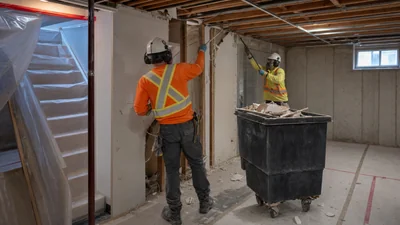
Homes built from the 1970s onward. Most of the work is interior: basements, kitchens and older backyard pools. The focus is protected stairs, clean carry routes and a tidy driveway.

Housing stock

Mississauga’s houses are newer than Toronto’s, but not new

Most of Mississauga was built after 1950, so it has fewer of the old brick rows found in central Toronto. The south end is mostly bungalows and split-levels from the 1950s and 1960s. The middle of the city grew through the 1970s and 1980s, and the north end is largely from the 1990s onward.

Homes built before the 1990s can still contain materials that need testing before they are disturbed, such as asbestos (a fibre once used in floor tile, plaster and pipe wrap) or lead paint. Ontario’s construction safety rules require the owner to have a designated substances survey done before demolition starts. That short report tells us whether a separate clean-up step has to come first.

Before structural demolition

Mississauga requires a Demolition Control Permit for homes

Mississauga requires a Demolition Control Permit under Demolition Control By-law 0045-2019 to demolish any dwelling unit. For fewer than six units the City charges no fee, but standard conditions apply, such as rebuilding within a set period. The owner or builder applies to the City.

Other rules can apply depending on the property. Any private tree with a trunk 15 cm (about 6 inches) across or more needs a City permit to be removed or injured. Listed heritage properties need 60 days’ notice before a structure is demolished. Land near the Credit River or Lake Ontario can fall under Credit Valley Conservation rules. NextSite does not file or promise approvals; we give your builder and the City a clear demolition scope, and the owner should confirm current requirements directly with Mississauga.

City of Mississauga residential demolition ↗

Municipal rules and fees can change. Confirm the current requirements for the address and scope directly with the municipality.

Common local scopes

Demolition services in Mississauga

What it costs

What demolition costs in Mississauga

These are the same planning ranges we publish on our service pages. Mississauga does not get a different rate card. The only added line is getting crews and equipment to the site, which depends on distance and is shown separately in your quote.

Typical pricing

Interior strip-out to studs $2–$7 / sq ft
Kitchen demolition $1,000–$3,500
Full finished-basement gut $2,500–$6,000
Detached single-car garage $2,500–$5,000
Bungalow teardown $15,000–$30,000
Two-storey house demolition $20,000–$45,000

Planning ranges only. Travel to the site, permit fees, testing and abatement are separate. A walkthrough produces a firm written quote.

A quote that holds up

What changes a Mississauga demolition quote

Distance is the first thing. Mississauga is outside our Thornhill home base, so getting crews and equipment there is shown as its own line in the quote instead of being buried in the price. Larger jobs, like teardowns, pool removals and whole-house strip-outs, make the most sense. For a very small job, a contractor closer to you may be the better value, and we will tell you so.

After that, it is the lot. A wide driveway lets equipment work straight at the structure. A treed lot, a gated backyard or a ravine edge may mean more hand work. We write down what comes out, what stays, whether the foundation and slab are included and how the site is left, so the quote matches the job.

See completed scopes in our before-and-after project journal, or send photos through the quote page.

Local questions

Demolition in Mississauga: FAQs

Do you work in Mississauga?

Yes. Mississauga is outside our core York Region and Toronto area, so we quote it job by job. Teardowns, pool removals and larger interior jobs are the best fit. Send the address and photos and we will tell you straight away whether it makes sense.

Do I need a permit to demolish a house in Mississauga?

Yes. Mississauga requires a Demolition Control Permit for any dwelling unit, and it usually comes with rebuilding conditions. The owner or builder applies to the City. Full details are on our Mississauga house demolition page.

Do I need a tree permit for a Mississauga demolition?

Often. Any private tree with a trunk 15 cm across or more needs a City permit to be removed or injured, and that includes damage from equipment. Tell us early which trees are staying so we can plan the route around them.

Is Mississauga priced differently from Toronto?

The work itself uses the same published ranges. The only difference is the cost of getting crews and equipment to Mississauga, which we show as its own line so you can see exactly what it is.

Can you remove an old pool in Mississauga?

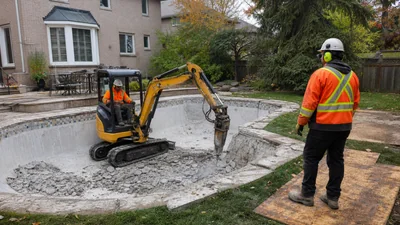
Yes. Our published ranges apply: $1,200–$3,500 for an above-ground pool, $6,000–$12,000 for an inground partial fill-in and $12,000–$20,000+ for a full inground removal. Backyard access is the biggest variable.

What should I send for a Mississauga demolition quote?

Send the address, photos of the work area and the route from the street, a note on what stays and any drawings or survey you have. Teardowns need a walkthrough before the price is final.

Planning demolition in Mississauga?

Send photos or call for a firm written scope and price.